
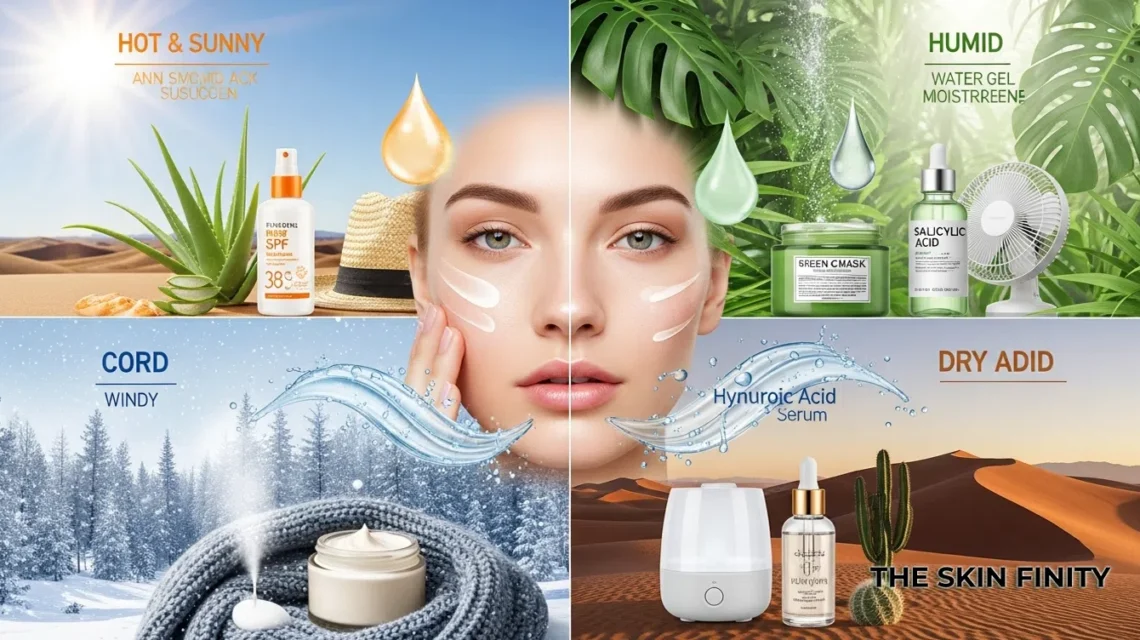
 The Skin Finity
 Have you ever returned from a dream vacation with perfectly clear, glowing skin, only to watch it throw a tantrum a week after coming home? Or perhaps your complexion feels balanced and soft in July but becomes tight, flaky, and irritable by January. If this sounds familiar, you’ve already experienced the most powerful force in skincare—one that no serum can fight alone. Your environment.
Your skin is not just reacting to the products you use; it’s in a constant, silent dialogue with the air around you. Temperature, humidity levels, wind, and sun exposure dictate your skin’s primary challenges. This means that the most effective skincare routine isn’t static—it’s a dynamic, responsive strategy. A one-size-fits-all approach fails because what works for a humid summer in Karachi won’t suffice for a dry, cold winter in Islamabad.
In this comprehensive guide, we’ll dive deep into the science of seasonal skincare and provide you with actionable, expert-backed routines for four key climate profiles: Hot, Humid, Cold, and Dry. Whether you’re battling oil control in humid summers or seeking the best moisturizer for dry skin in winter, consider this your master playbook for climate-adapted beauty.
Your Skin’s Foundation: More Than Just a Type
Before we tackle the weather, let’s establish a baseline. Your inherent skin type—be it oily skin, dry skin, combination, or sensitive—is your canvas. Climate is the painter, accentuating certain features and challenging others.
Two critical concepts to understand are:
- Dehydration vs. Dryness: Dehydration is a lack of water in the skin, which any skin type can experience. Dryness is a lack of oil (sebum). You can have oily yet dehydrated skin, especially in hot, arid climates.
- The Barrier is Everything: Your skin’s acid mantle and lipid barrier are its shield. Every climate-specific strategy we discuss ultimately aims to protect and strengthen this barrier against environmental factors. Think of this as the universal goal of all weather-adapted routines.
Now, let’s explore how to build your perfect, location-specific regimen.
Skincare for Hot & Sunny Climates
When the sun is high and the temperatures soar, your skin faces a unique set of aggressors. The primary goal here shifts to protection, antioxidant defense, and lightweight, sweat-friendly hydration.
The Skin Challenges You’ll Face
Intense UV protection in hot weather is non-negotiable, as UVA/UVB rays accelerate photoaging and hyperpigmentation. Heat can increase inflammation and redness, while sweat can mix with sebum and sunscreen, leading to clogged pores and potential breakouts. Despite the humidity, you can still experience water loss through perspiration.
Your Ideal Hot-Weather Daily Routine
Morning (Focus: Protection & Prevention)
- Cleanse: Use a gentle, refreshing gel or foaming cleanser to remove overnight impurities without stripping the skin.
- Treat: Apply a Vitamin C or antioxidant serum. This is your daily shield against pollution and free radical damage caused by intense sun exposure.
- Hydrate: Opt for a lightweight, oil-free moisturizer for humidity. Aloe vera or hyaluronic acid-based gels are perfect.
- Protect: The most crucial step. Apply a broad-spectrum SPF 30 or higher. Consider a mineral option with zinc oxide for added soothing benefits. Reapply every two hours if outdoors.
Evening (Focus: Repair & Refresh)
- Double Cleanse: Start with a micellar water or cleansing oil to dissolve sunscreen and sweat, followed by your gentle cleanser.
- Treat & Soothe: 2-3 times a week, use a chemical exfoliant like lactic acid. On other nights, a niacinamide or calming serum helps repair the barrier.
- Moisturize: Reapply your lightweight moisturizer to aid overnight recovery.
Key Ingredients & Product Picks
- Hyaluronic Acid: Draws moisture into the skin without heaviness.
- Niacinamide: A superstar for regulating oil, reducing redness, and strengthening the barrier.
- Vitamin C & Ferulic Acid: Potent antioxidant duo for anti-aging skincare in sunny weather.
- Zinc Oxide: The ideal physical sunscreen filter for sensitive, sun-exposed skin.
- Look for: Gel textures, fluid lotions, and mattifying serums for hot days.
Pro Tips & Common Pitfalls
- DO: Keep a facial mist in the fridge for a mid-day cooling spritz. Wear wide-brimmed hats and seek shade.
- DON’T: Skip sunscreen on cloudy days (UVA penetrates clouds). Over-exfoliate in an attempt to combat oiliness—this can damage your barrier and cause more oil production.
Skincare for Humid Climates
High humidity creates a sauna-like effect on your skin. While it can be hydrating, it often exacerbates oil production and creates a breeding ground for bacteria.
The Skin Challenges You’ll Face
The constant moisture in the air can lead to excessive sebum production, making skincare for oily skin a top priority. Pores are more prone to becoming clogged, and a specific type of breakout called fungal acne (Malassezia) can thrive. Makeup and skincare products may feel like they’re sliding right off your face.
Your Ideal Humid-Weather Daily Routine
Morning (Focus: Oil Control & Pore Care)
- Cleanse: Use a foaming cleanser, optionally with salicylic acid (BHA) or tea tree oil, to deeply cleanse pores.
- Tone: An alcohol-free, balancing toner with witch hazel or niacinamide can help tighten pores and control shine.
- Treat: A mattifying serum with niacinamide or zinc PCA is ideal for oil control skincare for humid summers.
- Moisturize/Protect: Choose a lightweight skincare for hot humid climates product—a water-gel moisturizer with SPF 30+ or a separate, oil-free sunscreen.
Evening (Focus: Deep Cleansing & Clarifying)
- Double Cleanse: This is essential. An oil-based cleanser will dissolve sebum and pollution, followed by your foaming cleanser.
- Exfoliate: Use a BHA (salicylic acid) toner or serum 2-3 times a week to keep pores clear. This is crucial for tropical climate pore care.
- Moisturize: Even oily skin needs hydration. A simple, non-comedogenic gel-cream will suffice.
Key Ingredients & Product Picks
- Salicylic Acid (BHA): Oil-soluble, meaning it can dive into pores to clear out debris.
- Niacinamide: Regulates sebum and minimizes pore appearance.
- Clay: In weekly masks, kaolin or bentonite clay draws out excess oil and impurities.
- Look for: Labels that say “oil-free,” “non-comedogenic,” “mattifying,” and “sebum-control.”
Pro Tips & Common Pitfalls
- DO: Use blotting papers throughout the day instead of piling on more powder. Ensure your products are fungal-acne safe if you’re prone to tiny, uniform bumps.
- DON’T: Strip your skin with harsh, alcohol-based astringents. This signals your skin to produce even more oil. Never skip moisturizer—dehydrated skin will overcompensate with oil.
Skincare for Cold & Windy Climates
Biting winds, low temperatures, and dry indoor heating create a perfect storm for your skin barrier. The focus here shifts dramatically from oil control to intense protection and nourishment.
The Skin Challenges You’ll Face
The cold air outside and dry heat inside lead to severe moisture loss, known as transepidermal water loss (TEWL). This compromises your skin barrier, leading to redness, sensitivity, itching, and pronounced flakiness. This is the prime time for addressing skincare for dry skin.
Your Ideal Cold-Weather Daily Routine
Morning (Focus: Barrier Fortification)
- Cleanse: Use a hydrating cream or milky cleanser. Avoid foaming formulas.
- Hydrate: Layer a hydrating toner or essence, followed by a serum rich in hyaluronic acid or peptides.
- Nourish: Apply a rich cream for cold seasons packed with ceramides, fatty acids, and cholesterol to mimic and support your skin barrier.
- Protect: SPF is still mandatory! UV rays reflect off snow. Use a moisturizing sunscreen.
Evening (Focus: Intensive Repair & Occlusion)
- Cleanse Gently: Repeat with your cream cleanser.
- Treat: This is a great time for anti-aging skincare in cold weather with retinoids or barrier-repair peptides.
- Moisturize & Seal: Apply your rich cream. On extra-dry areas, “slug” with a thin layer of petroleum jelly or a balm to lock in moisture—a key tactic in your hydration routine for cold climates.
Key Ingredients & Product Picks
- Ceramides: The building blocks of your skin barrier. Essential for barrier repair for cold air.
- Squalane: A plant-derived oil that mimics the skin’s natural sebum, providing deep hydration without greasiness.
- Shea Butter: A rich emollient that provides excellent moisture loss prevention.
- Peptides: Signal skin to produce more collagen, combating fine lines that can appear more prominent when skin is dry.
- Look for: Creams, balms, facial oils, and products labeled “barrier repair,” “nourishing,” or “rich.”
Pro Tips & Common Pitfalls
- DO: Apply moisturizer to damp skin to trap water. Run a humidifier in your bedroom. Protect your face with a scarf in windy conditions.
- DON’T: Take long, hot showers—they strip the skin’s natural oils. Over-exfoliate flaky skin; gently hydrate it instead. Neglect your SPF.
Skincare for Dry & Arid Climates
In desert-like conditions or high-altitude areas with low humidity, the air actively pulls moisture from your skin. The battle is purely about hydration and preventing water from escaping.
The Skin Challenges You’ll Face
The lack of atmospheric moisture leads to immediate dehydration, making fine lines more visible and causing a constant feeling of tightness. Skin can become itchy, sensitive, and may flake. This requires dedicated skincare for dry air and low humidity.
Your Ideal Arid-Climate Daily Routine
Your AM and PM routines are similar in their goal: intense, multi-layered hydration sealed in.
- Cleanse: Only with the gentlest, non-foaming, creamy or oil-based cleansers.
- Hydrate Aggressively: This is the core of hydration in dry climates. Use a hydrating mist, then a hyaluronic acid serum on damp skin, followed by a glycerin-based emulsion.
- Seal & Protect (AM): Use a moisturizer with occlusive ingredients. Follow with a hydrating sunscreen.
- Seal & Nourish (PM): Layer a nourishing face oil over your moisturizer, or use an overnight sleeping mask to act as a moisture seal.
Key Ingredients & Product Picks
- Hyaluronic Acid: Must be used correctly—applied to damp skin and sealed with a cream/oil to prevent it from drawing moisture from your skin in arid air.
- Glycerin: A powerhouse humectant that pulls water from the deeper layers of the skin and the environment.
- Jojoba Oil: Closely matches human sebum, providing an excellent protective layer.
- Polyglutamic Acid: A humectant even more powerful than hyaluronic acid.
- Look for: “Hydration-boosting,” “moisture-binding,” and “occlusive” properties in creamy, luxe textures.
Pro Tips & Common Pitfalls
- DO: The “sandwich” method: mist, humectant serum, moisturizer. Carry a facial mist. Pat products in; don’t rub.
- DON’T: Rely solely on hyaluronic acid serums without an occlusive top layer. Use harsh, stripping cleansers or high-pH soaps.
Smoothly Transitioning Between Seasons & Climates
Life isn’t static, and neither is your environment. Traveling or moving between seasons means your skincare routine must adapt. Here’s how to transition without shocking your skin:
- Anticipate the Shift: As a new season approaches, start phasing out one product at a time. Swap your lightweight moisturizer for a slightly richer one as autumn begins.
- Follow the 2-Week Rule: When introducing a new climate-specific product (like a heavy cream), patch test and then integrate it slowly over two weeks to monitor your skin’s response.
- Build a Travel Capsule Kit: Pack multi-tasking heroes: a gentle cleanser, a moisturizer that suits a range of conditions, a stable antioxidant serum (Vitamin C), a miniature facial oil (for dry climates), and your dependable SPF.
5 Common Climate Skincare Mistakes (And How to Fix Them)
- Mistake: Using the same moisturizer year-round.
- Fix: Have at least two: a lightweight gel/lotion for warm/humid months and a richer cream for cold/dry months.
- Mistake: Neglecting SPF in cold or cloudy weather.
- Fix: Make SPF a 365-day-a-year habit. UVA rays, which cause aging, are present at consistent strength all year.
- Mistake: Over-cleansing in dry climates, under-cleansing in humid ones.
- Fix: Match your cleanse to your climate: gentle in arid zones, thorough (often double) in humid zones.
- Mistake: Assuming oily skin doesn’t need moisture in dry climates.
- Fix: All skin types need hydration. Oily skin in the desert will benefit from a light, hydrating serum under a gel moisturizer to prevent dehydration-triggered excess oil.
- Mistake: Using products with high alcohol content to “dry out” oily skin.
- Fix: This damages the barrier. Opt for oil-control ingredients like niacinamide and salicylic acid instead.
Expert Insights: What Dermatologists Say
Dr. Ayesha, a cosmetic dermatologist, emphasizes: “The single most impactful change a person can make is to view their skincare as a responsive system, not a fixed protocol. Adjusting your skincare routine for different seasons based on humidity and temperature readings is more scientific than following rigid trends.”
Studies support this. Research in the International Journal of Dermatology has shown that low humidity alone can significantly impair skin barrier function and increase roughness within just a few days, underscoring the need for proactive barrier repair for cold air and arid environments.
Modern trends, like the K-beauty philosophy of lightweight, layered hydration, perfectly equip us for this adaptive approach, allowing for customization based on the day’s specific environmental needs.
Your Climate Skincare Questions, Answered
Q1: What is the best winter skincare routine?
A: A great winter skincare routine focuses on barrier repair and occlusion. Use a gentle cream cleanser, a hydrating toner, a serum with hyaluronic acid or ceramides, a rich moisturizer containing lipids, and never forget your sunscreen. Consider adding a facial oil at night.
Q2: How do I adjust my skincare for humid weather?
A: Shift to lightweight, non-comedogenic products. Incorporate a BHA (salicylic acid) to keep pores clear, use a foaming cleanser, and choose water-gel moisturizers. Double cleansing in the evening is crucial to remove excess sebum and pollution.
Q3: What’s the best moisturizer for dry skin in winter?
A: Look for the best moisturizer for dry skin in winter by checking labels for ceramides, shea butter, squalane, and cholesterol. The texture should be a rich cream or balm, not a lotion. Examples include formulations from brands like CeraVe, La Roche-Posay, or Eucerin.
Q4: Can I use hyaluronic acid in a dry climate?
A: Yes, but with a caveat. Hyaluronic acid is a humectant that draws moisture from its surroundings. In dry air, it may pull water from your skin. To use it effectively, apply it to damp skin immediately after cleansing and immediately seal it in with a moisturizer or face oil to lock in the hydration.
Q5: How do I control oil in humid summers without over-drying?
A: Balance is key. Use a niacinamide serum, which regulates oil production while strengthening the barrier. Follow with a lightweight, oil-free moisturizer to provide hydration. Use blotting papers instead of harsh powders or astringents throughout the day.
Q6: Does my skincare routine really need to change with the seasons?
A: Absolutely. Seasonal skin changes are a biological response to environmental shifts. Ignoring them means fighting an uphill battle against dryness in winter or excess oil in summer. Adapting your routine is the most effective way to maintain healthy, balanced skin year-round.
Q7: What’s the most important product for hot climate skincare?
A: Without a doubt, a high-quality, broad-spectrum sunscreen (SPF 30+). Reapplication is just as important as the initial application. This is your primary defense against premature aging and sun damage in hot climates.
Q8: How can I protect my skin from dry, indoor heating in cold months?
A: Combat indoor dryness by using a humidifier to add moisture back into the air. On your skin, layer hydrating products and finish with an occlusive moisturizer at night. Keep a hydrating facial mist at your desk for a quick moisture boost.
Your Personalized, Weather-Proof Strategy
Mastering your seasonal skincare is less about following rigid rules and more about becoming an astute observer—of the forecast and of your own skin. Start by identifying your primary climate challenge, then build your routine using the principles outlined here: protect in the heat, clarify in the humidity, nourish in the cold, and hydrate in the arid.
Let this guide be your starting point. Listen to your skin’s daily feedback—does it feel tight? Look shiny? Feel rough? These are clues to adjust your approach. With this knowledge, you’re no longer just applying products; you’re cultivating resilient, healthy skin that can thrive anywhere, in any season.
What’s your biggest climate-related skin challenge? Share your location and experience in the comments below—let’s build a community of weather-wise skincare enthusiasts!


