
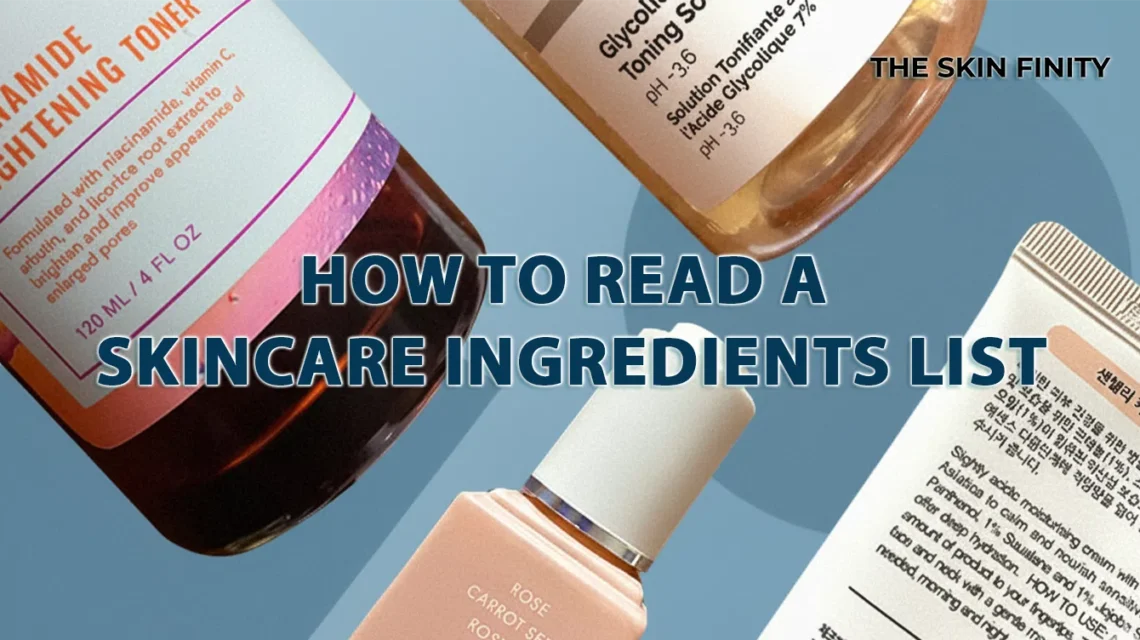
 The Skin Finity
 Have you ever stood in the skincare aisle, holding two nearly identical serums, while a wave of confusion washes over you? The front of the bottles shouts promises: “GLOWING SKIN!” “WRINKLE ERASER!” But when you flip it over, the back label reads like a cryptic, unpronounceable scientific abstract. Aqua, Glycerin, Dimethicone, Niacinamide, Phenoxyethanol… What does it all mean? Which one is actually better for your skin?
You’re not alone. For most beginners (and even seasoned skincare enthusiasts), reading a skincare ingredients list feels like decoding a foreign language. But what if I told you that this list is the most honest part of the entire product?
Think of it as your skincare’s nutrition label.
Just as you’d check the ingredients on a food package to avoid allergens or excess sugar, understanding skincare ingredient labels empowers you to see past the marketing hype and know exactly what you’re putting on your skin. It’s the key to avoiding irritants that cause redness, identifying the key ingredients to look for that truly target your concerns, and ensuring you get real value for your money.
This guide is your ultimate skincare ingredients list explained. We’ll break down the intimidating INCI ingredients system, teach you a simple step-by-step method for decoding skincare ingredients, and provide you with a clear cheat sheet of heroes and potential irritants. By the end, you’ll confidently pick up any product and know exactly what’s inside.
Let’s transform you from confused to confident.
The Fundamentals: How Skincare Ingredient Lists Actually Work
Before we dive into specific names, you need to understand the rulebook. Skincare labeling follows a global system designed for clarity—once you know the rules.
The Universal Language: What is INCI?
INCI stands for International Nomenclature of Cosmetic Ingredients. It’s the standardized, universal naming system used for ingredients in cosmetics and skincare across the USA, EU, and many other regions.
- Why the Scientific Names? You’ll see Latin names for plants (Aloe Barbadensis Leaf Juice for aloe vera) and scientific names for chemicals. This isn’t to confuse you! It ensures that an ingredient is called the exact same thing on a product made in Germany as it is on one made in Japan. It’s like the difference between a plant’s common name (e.g., “daisy”) and its precise botanical name (Bellis perennis). INCI is the precise, scientific identifier.
The Golden Rule: Ingredients in Descending Order
This is the single most important rule in understanding ingredient labels:
Ingredients are listed in order of concentration, from highest to lowest.
- The First 5 Ingredients: Typically, the first five ingredients make up the bulk of the product (often 80-90%). The very first ingredient is the main base—usually water (Aqua) in serums and creams, or an oil in balms.
- The 1% Threshold Rule: Ingredients present at a concentration of 1% or less can be listed in any order after the higher-concentration ingredients. How can you spot this threshold? Preservatives like Phenoxyethanol (often used at or below 1%), colorants, and potent actives like Retinol or Peptides (which are often effective at low percentages) frequently appear after this point.
- Practical Takeaway: When looking for your key skincare ingredients, note their position. If Hyaluronic Acid is listed last, it’s a trace amount. If it’s in the top half, it’s likely a star player.
What’s Not Listed & The Exceptions
- Fragrance/Parfum Loophole: The term “Fragrance” or “Parfum” can be a proprietary blend of dozens of chemicals, none of which have to be individually disclosed. This is a common source of hidden allergens.
- Trade Secrets: Rarely, a specific component of a fragrance or blend may be listed as “and other ingredients” if protected as a trade secret.
- No Exact Percentages: Unlike food, brands are not required to disclose the exact percentage of each ingredient, which is why understanding order is so crucial.
Your Step-by-Step Guide to Decoding Any Skincare Ingredients List
Let’s turn theory into practice. Follow this 4-step scan the next time you pick up a product.
Step 1: The First Glance – Identify the Product Type & Base
Look at the first ingredient. This tells you the vehicle.
- Aqua/Water/Eau First? You’re likely holding a lotion, cream, gel, or serum. It will be water-based.
- An Oil or Butter First? (e.g., Cocos Nucifera (Coconut) Oil, Shea Butter). This is a balm, oil blend, or rich cream. It will be more occlusive (moisture-sealing).
Step 2: Scan for Your “Hero” Actives (The Good Stuff)
Now, look for the key ingredients to look for based on your skin goal. Use the order rule to gauge their potency in the formula.
- For Hydration: Scan for Hyaluronic Acid (Sodium Hyaluronate), Glycerin, Panthenol. Are they in the top half?
- For Acne & Pores: Look for Salicylic Acid (BHA), Niacinamide, Zinc. Is the acid high enough to be effective?
- For Anti-Aging: Seek Retinol, Vitamin C (Ascorbic Acid or derivatives), Peptides. Their placement hints at stability and potency.
Step 3: Spot the Support Cast & Preservatives
These ingredients aren’t “actives,” but they make the product stable, spreadable, and safe. Don’t fear them.
- Emulsifiers: (Cetearyl Alcohol, Glyceryl Stearate) – Bind water and oil together in creams.
- Surfactants: (Cocamidopropyl Betaine) – Create lather in cleansers.
- Preservatives: (Phenoxyethanol, Potassium Sorbate, Benzyl Alcohol) – Crucial. They prevent bacterial and fungal growth. A “preservative-free” water-based product in a jar is a breeding ground for microbes.
Step 4: Check the Tail End for Potential Irritants
This is where skincare ingredients to avoid for sensitive skin often lurk, as they are used in small amounts.
- Fragrance/Parfum
- Essential Oils (e.g., Limonene, Linalool, Citrus Oils)
- Dyes (CI followed by numbers)
- Even some beneficial but potentially irritating actives, like Retinol, can be placed here in low-dose formulas.
The Hero Ingredient Glossary: Key Ingredients to Look For
Here’s a cheat sheet of powerhouse ingredients categorized by concern. These are the good skincare ingredients to know.
For Hydration & Barrier Repair
These ingredients attract, hold, and seal moisture.
- Hyaluronic Acid (Sodium Hyaluronate): A powerful humectant that can hold 1000x its weight in water. Looks for it in serums and moisturizers.
- Glycerin: A superstar humectant that is affordable, effective, and excellent for all skin types.
- Ceramides (e.g., Ceramide NP, AP): The essential lipids that make up your skin’s barrier. Key for repairing compromised, dry, or sensitive skin.
- Panthenol (Provitamin B5): A humectant that soothes and promotes skin healing.
- Squalane: A lightweight, non-comedogenic emollient derived from plants that mimics your skin’s own oils.
For Anti-Aging & Brightening
These ingredients target fine lines, wrinkles, and uneven tone.
- Retinoids (Retinol, Retinal, Retinyl Palmitate): The gold standard for stimulating collagen, reducing wrinkles, and speeding cell turnover. Start low and slow.
- Vitamin C (L-Ascorbic Acid): A potent antioxidant that brightens, protects against pollution/UV damage, and boosts collagen. Look for stable formulations in opaque, airless packaging.
- Niacinamide (Vitamin B3): A multi-tasking wonder. It reduces redness, minimizes pores, regulates oil, and improves barrier function. Works well with almost everything.
- Peptides (e.g., Palmitoyl Pentapeptide-4): Chains of amino acids that signal the skin to produce more collagen. Gentle and suitable for most.
For Acne, Oil Control & Congestion
These ingredients exfoliate, clear pores, and regulate sebum.
- Salicylic Acid (BHA): An oil-soluble exfoliant that dives into pores to dissolve clogs (blackheads, whiteheads). Ideal for oily, acne-prone skin.
- Benzoyl Peroxide: Kills acne-causing bacteria directly. Can be drying, so hydration is key.
- Azelaic Acid: Reduces inflammation, kills bacteria, and helps with post-acne redness and hyperpigmentation. Great for rosacea-prone acne.
- Niacinamide: Again! For acne, its oil-regulating and anti-inflammatory properties shine.
Proceed with Caution: Skincare Ingredients to Avoid (For Your Skin Type)
Let’s be clear: This is not a definitive list of “bad” ingredients. Context and concentration are everything. The goal is to know common irritants so you can identify your personal triggers—especially if you have sensitive, reactive, or allergy-prone skin.
Common Irritants & Allergens
- Fragrance/Parfum & Essential Oils: The number one cause of contact dermatitis in skincare. “Unscented” may still have masking fragrance; “Fragrance-Free” is the label to trust for true sensitivity.
- Denatured Alcohol (SD Alcohol 40, Ethanol, Isopropyl Alcohol) high on the list: Can be extremely drying, stripping, and disruptive to the skin barrier, especially in leave-on products. (Note: Fatty alcohols like Cetyl Alcohol are moisturizing and not problematic).
- Harsh Sulfate Surfactants: Sodium Lauryl Sulfate (SLS) in cleansers can be overly stripping for dry, sensitive, or eczema-prone skin types.
Ingredients with a Bad Rap vs. The Science
- Parabens (Methylparaben, Propylparaben): Effective preservatives that have been unjustly vilified. Major health and regulatory bodies worldwide (FDA, EU SCCS) consistently affirm their safety at low concentrations used in cosmetics.
- Silicones (Dimethicone, Cyclopentasiloxane): They create a smooth, velvety feel and help seal in moisture. They are non-comedogenic and do not “suffocate” the skin. However, some people prefer to avoid them for personal or environmental reasons.
- Mineral Oil: A highly refined occlusive that is non-comedogenic, hypoallergenic, and excellent for locking in moisture. It’s a misunderstood workhorse.
The Real Takeaway: Your skin is unique. An ingredient that causes a reaction for one person may be perfectly fine for another. Patch testing is your best friend.
Advanced Decoding: Tools, Tips & Real-World Examples
Harness Technology: INCI Decoder Apps & Websites
Don’t do this alone! Use these tools as a digital companion:
- INCI Decoder: A fantastic, detailed database explaining the function and comedogenic rating of thousands of ingredients.
- SkinSort: Allows you to paste a full ingredient list for analysis and find products with similar ingredients.
- How to Use Them: Paste the skincare ingredient list from an online retailer or type in ingredients from your product. Use the analysis as a guide, not an absolute verdict. Cross-reference with your own knowledge.
Real-World Label Breakdown
Example 1: A Popular Hydrating Serum
- INGREDIENTS: Aqua, Propanediol, Glycerin, Panthenol, Sodium Hyaluronate, Citric Acid, Ethylhexylglycerin, Phenoxyethanol.
- Decoded: Water base. Propanediol (a solvent/humectant) and Glycerin are high, meaning great hydration. Panthenol and Sodium Hyaluronate (HA) follow—this is a well-formulated hydrating serum with key actives positioned effectively. Phenoxyethanol is the preservative at the end.
Example 2: A “Natural” Cream
- INGREDIENTS: Aqua, Aloe Barbadensis Leaf Juice, Cocos Nucifera Oil, Glycerin, Butyrospermum Parkii Butter, Lavandula Angustifolia Oil, Citrus Aurantium Dulcis Oil, Tocopherol, Phenoxyethanol.
- Decoded: Water and Aloe base. Good moisturizing oils/butters. However, note the Lavender and Citrus (Orange) Essential Oils. These provide scent but are common sensitizers. For sensitive skin, this could be a red flag despite the “natural” appeal.
Reading Between the Lines: Marketing Terms Decoded
- “Dermatologist Tested”: Means a dermatologist was involved at some point. It does not guarantee it won’t irritate you.
- “Non-Comedogenic”: Means it’s unlikely to clog pores in tested individuals. Not a 100% guarantee for everyone.
- “Clean Beauty”: An unregulated marketing term. It often means the brand avoids a specific, self-determined list of ingredients (like parabens, sulfates, synthetic fragrance). Always verify by reading the INCI list yourself.
- “Fragrance-Free” vs. “Unscented”: Fragrance-Free should mean no added fragrance masking agents. Unscented often means they’ve added a masking fragrance to cover chemical smells.
Frequently Asked Questions About Skincare Ingredients and Labels
1. How do I read a skincare ingredients list?
Start with the first ingredient to know the base, scan the top third for your key actives, check the middle for emulsifiers, and review the end for preservatives and potential irritants like fragrance. Always remember the descending order rule.
2. What does the order of ingredients mean in skincare products?
It indicates concentration, from highest to lowest. The first ingredient is the most abundant.
3. What are the key skincare ingredients to look for?
It depends on your goal: Hyaluronic Acid and Ceramides for hydration; Retinol and Vitamin C for anti-aging; Salicylic Acid and Niacinamide for acne/oily skin.
4. What skincare ingredients should I avoid?
There’s no universal list, but if you have sensitive skin, be cautious of Fragrance/Parfum, Essential Oils, and high concentrations of Denatured Alcohol in leave-on products. Identify your personal triggers.
5. What are good skincare ingredients for dry skin?
Look for humectants (Glycerin, Hyaluronic Acid), emollients (Squalane, Jojoba Oil), and occlusives/barrier repair agents (Ceramides, Shea Butter).
6. What are bad skincare ingredients for sensitive skin?
Fragrance (synthetic and natural from essential oils) is the most common culprit. Harsh solvents and some essential oils (like citrus, peppermint) are also frequent irritants.
7. How to understand skincare labels as a beginner?
Focus on learning 5-10 common key ingredients for your concern and the descending order rule. You don’t need to memorize everything.
8. What is INCI in skincare ingredients?
It’s the International Nomenclature of Cosmetic Ingredients—the standardized global system for naming ingredients on labels.
9. Are natural skincare ingredients always better?
No. “Natural” does not equal safe or effective. Poison ivy is natural. Many synthetic ingredients are rigorously tested, stable, and highly effective. Focus on ingredient safety and formulation quality, not the source.
10. What to look for in skincare ingredients for acne?
Beta Hydroxy Acid (BHA/Salicylic Acid) to clean pores, Niacinamide to reduce oil and inflammation, and Azelaic Acid for its antibacterial and brightening properties.
11. How can I use an INCI decoder for skincare?
Copy and paste a product’s ingredient list from an online store or type it into a site like INCI Decoder. It will color-code and explain each component’s function.
12. Why are some skincare ingredients listed in Latin?
This is part of the INCI standard for botanical ingredients. It ensures precise identification of the plant species used (e.g., Rosmarinus Officinalis for rosemary).
13. Can skincare ingredients expire or go bad?
Yes! Always look for the Period After Opening (PAO) symbol—an open jar icon with a number like “6M” or “12M.” This tells you how many months the product is good for after opening. Preservatives help, but products do degrade.
14. What skincare ingredients should I not mix?
- For Beginners: Avoid combining strong direct acids (like Glycolic Acid) with strong Retinol in the same routine, as it can cause irritation. Use them on alternate nights.
- Debunked Myth: Niacinamide and Vitamin C can generally be used together. Older studies suggesting conflict used unstable forms under unrealistic conditions. Modern formulations are typically fine.
You Are Now an Informed Skincare Detective
Let’s recap your new skincare ingredient cheat sheet knowledge:
- Order is Power: The first five ingredients tell the main story.
- INCI is Your Friend: It’s the universal translator for what’s in the bottle.
- Know Your Heroes: Identify the key ingredients to look for that match your skin goals.
- Spot Your Personal Red Flags: Use the tail end of the list to check for your known irritants.
Empowerment in skincare isn’t about achieving perfection or memorizing a chemistry textbook. It’s about having the confidence to pick up a product, flip it over, and understand the story its ingredients list is telling you. It’s about making intentional, informed choices for your unique skin.
Right now, grab one product from your shelf. Apply your new 4-step scan. What’s the base? Where are the actives? Do you see fragrance? You’re no longer guessing—you’re decoding.


 The Invisible Architects: How Your Hormones Dictate Your Skin’s Health, Glow, and Age
  The Ultimate Skincare Routine for Night Shift Workers: Adapting Your Regimen to Irregular Sleep
  Fading Sun Damage: Your Expert Guide to Reversing Spots and Uneven Tone
  Understanding Skin Texture: Smooth vs. Rough and How to Improve It
  Niacinamide Benefits: The Science of Calming Inflammation and Evening Skin Tone
  Building a Minimalist Skincare Routine for Busy Professionals