

 The Skin Finity
 The Beginner’s Guide to a Simple, Effective Daily Skincare Routine
Feeling overwhelmed by 10-step routines and shelves full of serums? You’re not alone. The world of skincare can seem incredibly complex, leaving beginners feeling lost and frustrated. Maybe you’ve tried a complicated regimen only to give up after a week, or perhaps you’re staring at an aisle of products with no idea where to start. Here’s the secret the beauty industry doesn’t always tell you: for beginners, a simple skincare routine built on consistency is infinitely more powerful than a complex, unsustainable one.
Dermatologists consistently preach a “less is more” philosophy for those new to skincare. The goal isn’t to use every trendy ingredient but to master the foundational steps that every effective routine is built upon. This guide is your roadmap out of the confusion. We’ll strip skincare back to its essentials, providing a clear, step-by-step skincare routine for morning and night. You’ll learn the essential skincare steps, understand why order matters, and get trustworthy product recommendations—all without the jargon or overwhelm. By the end, you’ll have the confidence to start a basic skincare routine that protects, nourishes, and reveals your healthiest skin. Let’s begin.
Skin Basics 101: What Every Beginner Needs to Know
Before we dive into products and steps, let’s build a simple foundation of understanding. Think of this as learning the rules of the road before you start driving. Knowing these core concepts will help you make smarter choices and understand why you’re doing each step.
Understanding Your Skin Type: The First Step
Your skin type is the baseline for everything you do. Using products formulated for oily skin when yours is dry is a recipe for irritation, and vice-versa. The four basic types are:
- Oily: Skin appears shiny, especially in the T-zone (forehead, nose, chin). Prone to enlarged pores and breakouts.
- Dry: Skin may feel tight, look flaky or rough, and can be prone to redness or fine lines.
- Combination: The most common type. Features an oily T-zone with normal to dry cheeks.
- Normal: Balanced skin—not too oily, not too dry. Minimal pores and few blemishes.
- Sensitive: Skin that is easily irritated, stings, or becomes red in response to products or environmental factors. It can coincide with any of the above types.
A Simple “How-To”: Determine Your Skin Type at Home
Wash your face with a gentle cleanser, pat dry, and leave it bare for 60 minutes. After an hour, press a clean blotting paper or tissue to different areas of your face. Do you see oil on the paper from all areas? You’re likely oily. Is there no oil at all, and does your skin feel tight? You’re probably dry. Oil only on the forehead, nose, and chin points to combination skin. Remember: Your skin type can change with age, season, and climate, so this is just your starting point.
Your Skin Barrier: The Guardian You Need to Protect
Imagine your skin’s outermost layer as a brick wall. The skin cells are the bricks, and lipids (fats) are the mortar that holds them together. This is your skin barrier, and its job is crucial: it keeps moisture in and irritants, pollutants, and bacteria out. A healthy barrier means hydrated, resilient, and calm skin. A damaged barrier leads to dryness, sensitivity, redness, and breakouts.
Many common beginner skincare routine mistakes—like over-cleansing, over-exfoliating, or using harsh products—can damage this delicate wall. The entire purpose of a basic daily skincare routine is to support and protect this barrier, not attack it. Every step we discuss should be seen as an act of reinforcement for your skin’s natural defenses.
The Golden Rule: Consistency Over Complexity
You wouldn’t expect to get fit by going to the gym once a month. Skin health works the same way. Consistency is everything. Using a simple daily skincare routine every morning and night for 4-6 weeks is far more effective than using a 10-product cocktail sporadically. Skin cell turnover takes about a month, so you need to give products time to work.
Finally, let’s establish the one non-negotiable, career-long rule of skincare: Sunscreen is not optional. UV rays are the primary cause of premature aging (like wrinkles and dark spots) and skin cancer. No effective daily skincare routine is complete without it. Consider sunscreen the ultimate shield that protects all your other efforts.
Your Simple, Step-by-Step Daily Skincare Routine
Now, let’s build your routine. We’re creating two minimalist frameworks: one for morning and one for night. Remember, this is a minimalist skincare routine. We’re starting with the absolute essentials. You can always add one targeted treatment later, but only after you’ve mastered these core steps consistently.
The Morning Skincare Routine: Protect and Prep (3 Steps)
The philosophy of your morning skincare routine is protection. Your skin needs hydration and a shield against the environmental stressors (UV rays, pollution) it will face all day. This should be a quick, efficient process.
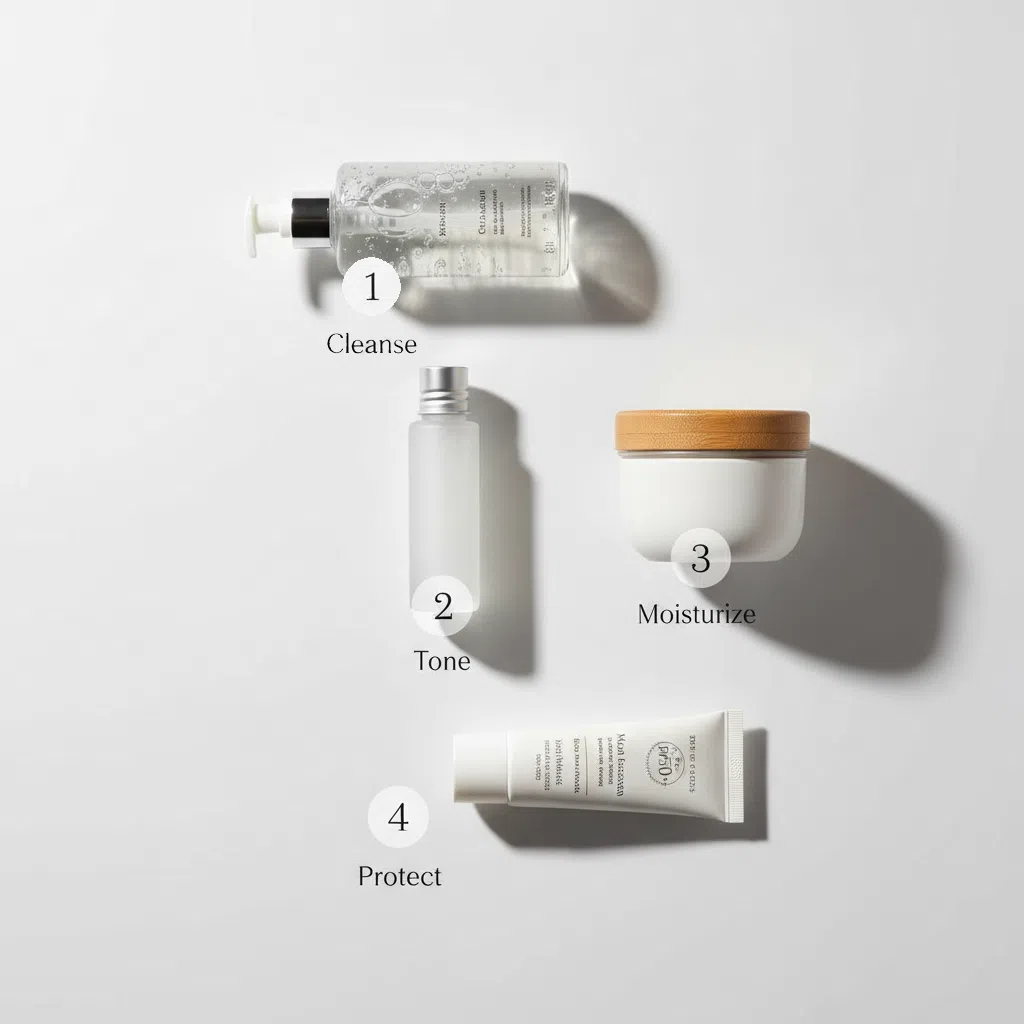
Step 1: Cleanse (or Rinse)
- The Goal: Gently remove any sweat or overnight products without stripping the skin.
- The How: For most beginners, especially those with dry or normal skin, splashing with lukewarm water is sufficient in the morning. If you have very oily skin or used a heavy treatment cream overnight, a gentle, hydrating cleanser is a good choice.
- Product Picks: Look for terms like “hydrating,” “gentle,” or “cream cleanser.” A basic, affordable drugstore facial cleanser works perfectly.
Step 2: Moisturize
- The Goal: Hydrate your skin and create a smooth, balanced base.
- The How: Apply a dime-sized amount to slightly damp skin. This helps lock in water. Don’t skip this, even if you have oily skin! A good, oil-free moisturizer signals to your skin that it doesn’t need to overproduce oil.
- Product Picks: A lightweight lotion or gel-cream is ideal for daytime under sunscreen. For dry skin, a slightly richer cream may be needed.
Step 3: Sunscreen (THE MOST IMPORTANT STEP)
- The Goal: Protect your skin from UVA (aging) and UVB (burning) rays.
- The How: Apply a generous amount—about a shot glass full for face and neck—as the absolute last step of your morning routine. Reapply every two hours if you’re in direct sun.
- Product Picks: Choose a broad-spectrum SPF 30 or higher. Formulas have improved dramatically; you can find lightweight, non-greasy options that feel like a primer. This is the most important product in your entire skincare routine for beginners.
The Nighttime Skincare Routine: Cleanse and Repair (3-4 Steps)
Your night skincare routine is all about recovery and treatment. This is when your skin goes into repair mode, making it the ideal time to cleanse away the day and support its natural renewal process.
Step 1: Cleanse (The Double Cleanse Option)
- The Goal: Thoroughly remove sunscreen, makeup, oil, and pollution. This is the most important step of your night routine.
- The How: If you wear makeup or heavy sunscreen, consider “double cleansing.” First, use an oil-based cleanser or micellar water to dissolve makeup and sunscreen. Follow immediately with a water-based cleanser to clean the skin itself. If you wear little makeup, a single cleanse with a gentle cleanser is fine.
- Product Picks: An affordable cleansing balm, oil, or micellar water for Step 1, followed by your gentle facial cleanser.
Step 2: Treat (Optional & Beginner-Cautious)
- A CRITICAL NOTE: Beginners should master the core three steps (Cleanse, Moisturize, Sunscreen) for at least a month before even considering this step. When you’re ready, introduce one treatment product, once a week, and gradually increase.
- The Goal: Address a specific concern like dullness, occasional breakouts, or fine lines.
- The How: Apply a small amount after cleansing and before moisturizing. Start slow!
- Product Picks: A gentle PHA for dullness, a niacinamide serum for pores, or a pea-sized amount of adapalene gel (a retinoid available over-the-counter) for acne. Always patch test first.
Step 3: Moisturize
- The Goal: Lock in hydration and all previous products, and support your skin’s overnight repair.
- The How: Apply a slightly thicker cream than you might use in the AM. This is the comforting, final layer that seals everything in.
- Product Picks: A nourishing night cream or a thicker version of your daytime moisturizer.
Pro Tips for Your Beginner Skincare Journey
You have your framework. Now, let’s talk about the pitfalls to avoid and how to make this routine truly work for you.
Common Beginner Mistakes (And How to Avoid Them)
- Introducing Too Many New Products at Once: Start with a basic cleanser, moisturizer, and sunscreen. Wait 4-6 weeks before adding anything else. If you react, you won’t know the culprit.
- Over-Exfoliating: Exfoliation is a treatment step. Beginners should start with a gentle chemical exfoliant (like a PHA or low-concentration lactic acid) once a week, max.
- Using Products in the Wrong Order: Remember the skincare routine order mantra: Thinnest to thickest consistency. Watery serums before creamy moisturizers. Sunscreen is always last in the AM.
- Skimping on Sunscreen: Not applying enough, or forgetting to reapply, undermines your entire routine and skin health.
- Giving Up Too Soon: Skin needs at least one full cycle (28 days) to show changes. Be patient and consistent.
Budget-Friendly & Beginner-Approved Product Picks
You do not need expensive products to start an effective daily skincare routine. Here are accessible, dermatologist-recommended brands to look for:
- Cleansers: CeraVe Hydrating Cream-to-Foam Cleanser, La Roche-Posay Toleriane Hydrating Gentle Cleanser, Vanicream Gentle Facial Cleanser.
- Moisturizers: CeraVe Daily Moisturizing Lotion (AM/PM), Cetaphil Daily Hydrating Lotion, Neutrogena Hydro Boost Gel-Cream.
- Sunscreens: EltaMD UV Clear Broad-Spectrum SPF 46, La Roche-Posay Anthelios Melt-in Milk Sunscreen SPF 60, Hero Cosmetics Force Shield Superlight Sunscreen SPF 30.
How to Adapt Your Simple Routine
- For Dry Skin: Opt for a cream or milky cleanser and a richer, ceramide-packed moisturizer. You might skip the morning cleanse and just rinse with water.
- For Oily/Acne-Prone Skin: A gentle foaming or salicylic acid cleanser (used once daily) and an oil-free, non-comedogenic moisturizer are key. Look for “niacinamide” in products.
- For Sensitive Skin: Your mantra is “fragrance-free” and “minimal ingredient lists.” Stick to brands built for sensitivity (like Vanicream, Aveeno Calm + Restore) and always, always patch test.
- Seasonal Shifts: In humid summer, you may prefer a gel moisturizer. In dry winter, switch to a heavier cream and consider a humidifier.
Frequently Asked Questions (FAQs) for Skincare Newbies
You asked, we’re answering! Here are the most common questions from those starting a skincare routine for beginners.
1. How many steps should a beginner skincare routine have?
Start with 3-4 steps maximum: Cleanser, Moisturizer, and Sunscreen (AM). At night, Cleanser and Moisturizer. That’s it. Master this before adding anything else.
2. What is the correct order for a skincare routine?
The golden rule: Apply products from thinnest consistency to thickest. Typically: Cleanser > Treatment (like a serum) > Moisturizer > Sunscreen (AM only).
3. Do I really need both morning and night routines?
Yes, but they serve different purposes. Morning = Protection (sunscreen). Night = Recovery (cleansing, repair). You can keep both routines very simple.
4. Can I use the same products morning and night?
Often, yes. Your cleanser and moisturizer can usually do double duty. The key exceptions: Sunscreen is for AM only, and potent treatments (like retinoids) are for PM only.
5. How long does it take to see results from a new skincare routine?
For hydration and smoothness, you might see changes in days. For concerns like acne or hyperpigmentation, give it a full 4-6 weeks (one skin cycle) to judge fairly.
6. Is expensive skincare worth it for beginners?
No. Start with affordable, well-formulated drugstore basics. Learn what your skin needs and reacts to before investing in pricier products.
7. Should beginners use retinol or acids?
With extreme caution. Master the basic routine first. If you want to introduce one, start with a low concentration, use it once a week at night, and always follow with moisturizer.
8. What if I have sensitive skin?
Focus on fragrance-free, gentle formulas. Look for calming ingredients like oat, ceramides, and niacinamide. Introduce one new product at a time and patch test on your inner arm first.
9. How often should I exfoliate as a beginner?
Start with a gentle chemical exfoliant (like mandelic acid or PHA) just once per week. You can gradually increase to 2-3 times if your skin tolerates it. Never exfoliate daily.
10. Do I need a separate eye cream?
Not essential for beginners. Your facial moisturizer is often perfectly suitable for the eye area. If you have specific concerns (severe dark circles, wrinkles) later, you can explore one.
11. Can I skip moisturizer if I have oily skin?
No! Skipping moisturizer can actually cause your skin to produce more oil to compensate for perceived dryness. Use a lightweight, oil-free, or gel-based moisturizer.
12. How do I know if a product is breaking me out or just “purging”?
Purging happens only with active ingredients that increase cell turnover (like retinoids, AHAs/BHAs) and appears as small whiteheads in areas you normally break out. It should clear in a few weeks. A true breakout or allergic reaction (red rash, itchy bumps, cysts in new areas) means you should stop using the product.
Your Skin Journey Starts Now
Building a skincare habit is a journey of self-care, not a race to perfection. You now have the blueprint for a simple, effective daily skincare routine that works. Remember, the core pillars are unwavering: Cleanse to refresh, Moisturize to hydrate, and Protect with sunscreen every single morning.
Start tonight. You don’t need a cabinet full of products—just a gentle cleanser and a moisturizer. Wash your face, apply your cream, and you’ve begun. Consistency with these simple acts is the most powerful “skincare secret” that exists. Be patient with your skin and with yourself. Avoid the temptation to add five new serums next week. Let your skin adjust, observe how it feels, and enjoy this new ritual.
Bookmark this guide as your personal reference. We’d love to hear about your progress! Share your first week’s experience or your favorite simple product find with our community. Here’s to starting simple and building a lifetime of healthy skin habits.


 Skincare Myths Debunked: Evidence-Based Facts & Future Trends for 2026
  The Ultimate Skincare Routine Order Guide: What Dermatologists Say Actually Works
  Niacinamide Benefits: The Science of Calming Inflammation and Evening Skin Tone
  Building a Minimalist Skincare Routine for Busy Professionals
  Serums vs. Moisturizers: What’s the Difference and Do You Need Both?
  Moisturizer 101: Why Everyone Needs One (Yes, Even Oily Skin)