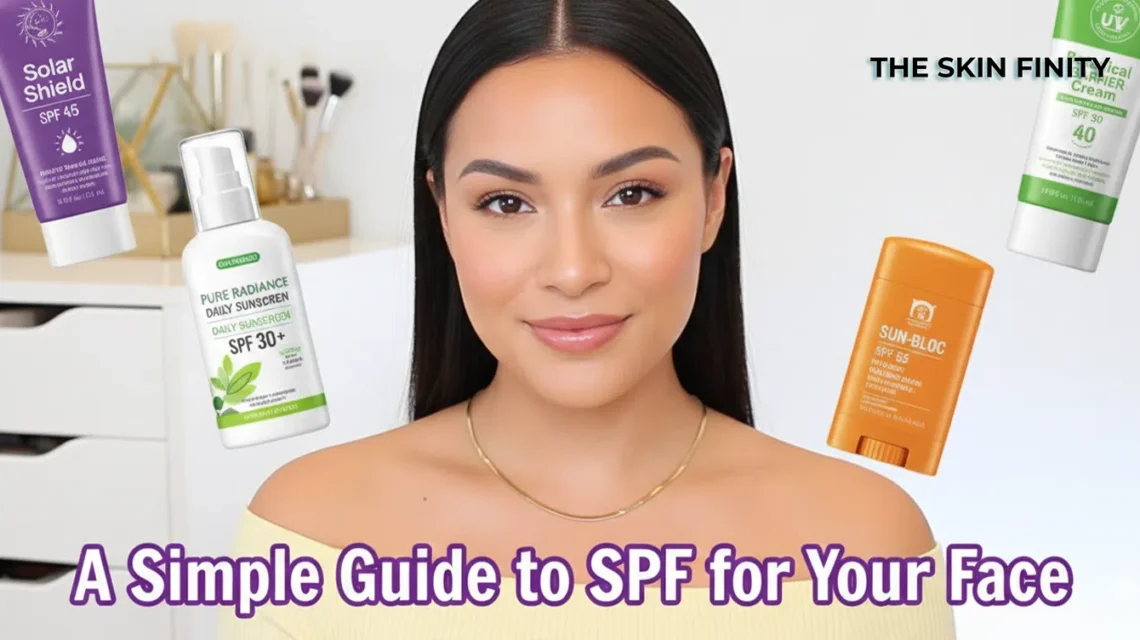
 The Skin Finity
 Remember that “just one day” you skipped sunscreen because it was cloudy, only to end up with a surprise pink glow by evening? Or the fine lines around your eyes that seem to have settled in a little too comfortably? If you’ve ever treated sunscreen as an optional beach-day accessory rather than a daily necessity, you’re in the right place.
Many of us have been there—struggling with formulas that feel greasy, leave a ghostly white cast, or simply don’t play nice with our skincare and makeup.
But here’s the non-negotiable truth: daily face sunscreen is the single most effective product in your skincare arsenal for preserving your skin’s health, youth, and clarity. It’s not just about avoiding sunburn; it’s about preventing up to 90% of visible aging, protecting against skin cancer, and maintaining an even skin tone.
This guide is here to cut through the confusion, debunk the myths, and provide you with a straightforward, no-nonsense approach to making SPF for face an effortless, non-skippable habit. Let’s transform this essential step from a chore into the simplest act of self-care you do every day.
Why Your Face Needs Sunscreen Every. Single. Day. (The Science, Simplified)
Think of your facial skin as the most valuable fabric you own—constantly exposed to elements that fray its edges and fade its color. Sunscreen is the protective coating that keeps it pristine. The damage comes from two types of invisible ultraviolet (UV) rays: UVA and UVB. Understanding them is key to understanding why any facial sunscreen worth its salt must be “broad spectrum.”
UVA vs. UVB: The “Aging” vs. “Burning” Rays
Imagine UV rays as two different types of invaders. UVB rays are the obvious ones. They’re the “Burning” rays, primarily responsible for that painful, red sunburn and playing a key role in the development of skin cancer. They’re most intense between 10 a.m. and 4 p.m., especially in the summer months.
UVA rays, however, are the stealthy, deep-penetrating “Aging” rays. They maintain the same intensity year-round, can pass through clouds and glass, and penetrate deep into the dermis—the skin’s foundational layer. Here, they wreak silent havoc by breaking down collagen and elastin, the proteins that keep your skin firm and plump. This leads to wrinkles, sagging, and a loss of elasticity. UVA is also the primary driver of hyperpigmentation, triggering and darkening age spots, melasma, and sun spots.
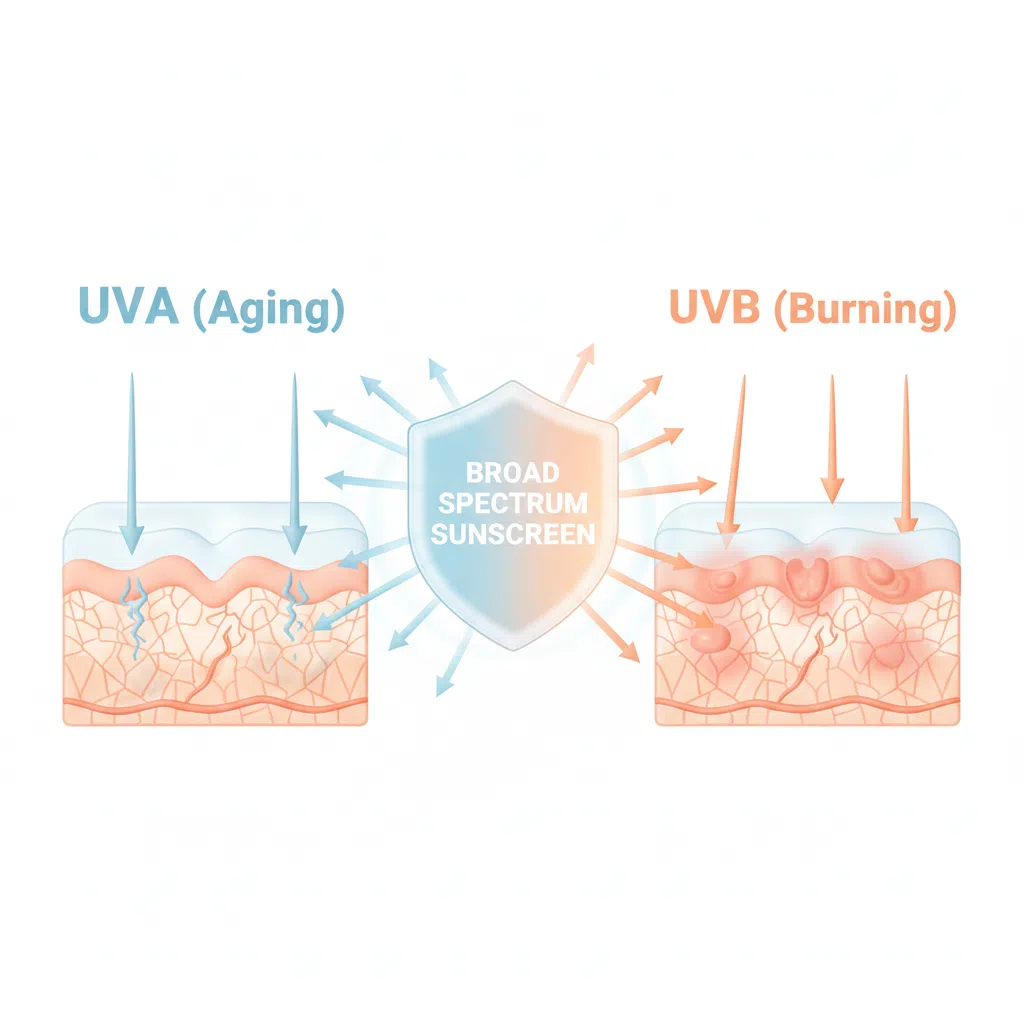
The takeaway? You need protection from both. This is where the term broad spectrum sunscreen face becomes crucial. A broad-spectrum formula is your comprehensive shield, guarding against both the immediate burn (UVB) and the long-term, silent aging and damage (UVA). Skipping this is like locking only one of your two front doors.
Beyond Sunburns: The Lifelong Benefits of Wearing Sunscreen Daily
The benefits of making daily sunscreen for face a habit extend far beyond avoiding a painful peel. It’s your most powerful long-term investment in your skin’s future.
- Your #1 Anti-Aging Strategy: Consistent sunscreen use is proven to prevent photoaging—the wrinkles, leathery texture, and loss of firmness caused by the sun. It’s more effective than any expensive retinol or peptide serum at preventing these signs in the first place.
- The Ultimate Pigmentation Peacekeeper: Whether you struggle with post-acne marks, melasma, or general uneven tone, daily SPF is non-negotiable. UV exposure stimulates melanin production, darkening existing spots and prompting new ones. No treatment for dark spots will be fully effective without it.
- Skin Cancer Prevention: This is the most critical reason. Skin cancer is one of the most common cancers, and the face is a high-exposure area. Regular use of SPF 15 or higher can reduce your risk of developing squamous cell carcinoma by about 40% and melanoma by 50%.
- Overall Skin Health: Sun damage weakens your skin’s barrier, making it more prone to dryness, sensitivity, and inflammation. A consistent daily SPF routine helps maintain a stronger, more resilient, and healthier complexion.
Decoding the Label: SPF, Types, and What “Reef Safe” Really Means
Walking down the sunscreen aisle can feel like reading a foreign language. Let’s decode the key terms so you can shop with confidence.
SPF Numbers Demystified: Is SPF 100 Twice as Good as SPF 50?
SPF (Sun Protection Factor) is a measure of UVB protection only. It indicates how long UVB rays would take to redden your skin compared to unprotected skin. For example, if you burn in 10 minutes without sunscreen, SPF 30 theoretically protects you for 300 minutes.
However, this is a flawed real-world gauge because application is rarely perfect, and we sweat, touch our faces, and wear hats. More importantly, the protection scale is not linear. There’s a law of diminishing returns:
- SPF 15 blocks about 93% of UVB rays.
- SPF 30 blocks about 97%.
- SPF 50 blocks about 98%.
- SPF 100 blocks about 99%.
No sunscreen blocks 100%. The jump from SPF 30 to 50 offers only 1% more UVB filtration, but dermatologists often recommend SPF 30 as the absolute minimum for daily use, with SPF 50 for face being an excellent target for extended outdoor exposure. The most important factor is applying—and reapplying—the correct amount.
Mineral vs. Chemical Sunscreen for Face: Choosing Your Shield

This is the biggest fork in the road when choosing a best facial sunscreen. Both are effective when used correctly; the difference lies in how they work and feel.
| Feature | Mineral (Physical) Sunscreen | Chemical Sunscreen |
|---|---|---|
| Active Ingredients | Zinc Oxide, Titanium Dioxide | Avobenzone, Octinoxate, Oxybenzone, Homosalate, etc. |
| How It Works | Sits on top of skin, acting like a mirror to physically reflect and scatter UV rays. | Absorbs into skin, where it converts UV rays into heat, then releases it. |
| Pros | Immediately effective upon application. Less likely to irritate, making it ideal for sensitive skin. Often more stable in sunlight. | Tends to be lighter, more cosmetically elegant, and easier to blend without a white cast. |
| Cons | Can feel heavier or leave a whitish residue (white cast), especially on deeper skin tones. Can rub off more easily. | Requires 15-20 minutes to become effective. Has a higher chance of stinging or causing reactions in very sensitive skin. |
The Bottom Line: The best sunscreen for face is the one you will wear generously and consistently. If you have sensitive or reactive skin, a mineral sunscreen for face is typically the safest bet. If cosmetic elegance and a sheer finish are your top priorities, a well-formulated chemical sunscreen might be your winner. Many modern “hybrid” formulas now combine both for a balanced approach.
Other Key Label Terms
- Water-Resistant: This is not “waterproof.” It must state a time (40 or 80 minutes), meaning it maintains its SPF level while swimming or sweating for that duration. You must reapply immediately after that time is up or after towel-drying.
- Reef-Safe/Coral-Friendly: This is an unregulated marketing term. It generally means the formula is free of oxybenzone and octinoxate, two chemical filters that some studies have shown can harm coral reefs. If ocean conservation is important to you, look for mineral-based sunscreens or check the ingredient list.
Finding Your Holy Grail: How to Choose the Best Facial Sunscreen
With the basics decoded, let’s match you with your perfect formula. The golden rule: Texture is everything. It must feel good on your skin, or you won’t use it.
By Skin Type & Concern
- For Oily & Acne-Prone Skin: Seek out “oil-free,” “non-comedogenic,” or “mattifying” labels. Lightweight fluids, gels, or gel-creams are your friends. Look for ingredients like niacinamide which can help control shine. Avoid heavy, occlusive creams.
- For Dry Skin: You want hydration. Look for “hydrating,” “nourishing,” or creams and lotions that contain humectants like hyaluronic acid or glycerin, and emollients like squalane or ceramides to support your skin barrier.
- For Sensitive & Reactive Skin: Mineral sunscreen for face is typically your safest harbor. Prioritize “fragrance-free,” “hypoallergenic,” and formulas with soothing ingredients like centella asiatica or panthenol. Avoid chemical filters, alcohol, and essential oils.
- For Darker Skin Tones: The dreaded white cast is a real barrier. The market has improved dramatically! Look for “sheer,” “universal tint,” or specifically marketed no white cast sunscreen. Modern micronized or “invisible” zinc oxide formulas, chemical sunscreens, or tinted facial sunscreen are excellent options.
For Your Lifestyle & Routine
- Sunscreen Under Makeup: The key is a fast-absorbing, lightweight formula that acts as a primer. Lotions or fluid textures are ideal. Apply your sunscreen, then wait a full 2-3 minutes for it to set completely before applying foundation. This prevents pilling.
- Tinted Facial Sunscreen: A game-changer for many. It offers sheer, natural coverage while providing sun protection. It’s perfect for “no-makeup” days, helps neutralize any minimal white cast from mineral filters, and often contains iron oxides, which protect against visible light (especially beneficial for those with melasma).
- For Active Lifestyles & Sports: Prioritize high SPF (50+), water-resistant (80-minute) formulas. Look for terms like “sweat-resistant” and “sport.” Stick sunscreens are also great for easy, mess-free reapplication on the go.
The Art of Application: How to Apply Sunscreen on Face Correctly
Even the world’s best sunscreen is useless if you don’t apply it correctly. This is where most people fall short.
The Golden Rule: How Much Sunscreen to Apply on Face
Under-application is the most common mistake, drastically reducing your protection. The standard dermatologist-recommended amount for the face and neck is two finger-lengths.
- Squeeze a continuous line of sunscreen along the length of both your index and middle fingers.
- That amount is roughly ½ teaspoon (or 1.25 ml) for the face alone. Add a little more for your neck and ears.
- Visual Method: Dot sunscreen generously in 11 key spots: forehead, nose, chin, each cheek, each side of your neck, and the front of your neck.
Applying only half the required amount can reduce the SPF protection by as much as two-thirds. An SPF 30 can effectively become an SPF 10.
Step-by-Step: How to Apply Facial Sunscreen
- When: Always as the final step in your morning skincare routine, after moisturizer but before any makeup or primer.
- How: Dot the measured amount all over your face and neck. Using gentle, upward strokes, blend thoroughly until it’s completely absorbed. Don’t forget your ears, eyelids (use a gentle stick formula here if needed), hairline, and under your chin/jaw.
- Wait Time: If using a chemical sunscreen, you must wait 15-20 minutes after application before sun exposure for it to become effective. Mineral sunscreen works immediately upon application.
The Reapplication Reality
Sunscreen breaks down over time with sun exposure. The rule is to reapply every two hours of cumulative sun exposure.
- Real-World Tip: Set a phone reminder. For sunscreen under makeup, use an SPF powder or a cushion compact SPF for touch-ups. A tinted facial sunscreen can also be patted over makeup lightly. When outdoors for long periods, reapply the full two-finger amount over cleansed skin if possible.
Busting the Biggest Sunscreen Myths
Let’s dismantle the misinformation that might be holding you back from consistent protection.
- Myth 1: “I have dark skin, so I don’t need sunscreen.”
Truth: While melanin provides a small amount of natural protection (approx. SPF 3-13), it does not shield against UVA damage, skin cancer, or hyperpigmentation. Everyone, regardless of skin tone, needs daily SPF. - Myth 2: “It’s cloudy/rainy today, so I’m safe.”
Truth: Up to 80% of UV rays can penetrate cloud cover. If it’s light enough to see outside, UV rays are present. - Myth 3: “I’m sitting by a window/indoors all day.”
Truth: UVA rays penetrate glass. If you work near a window, drive frequently, or sit by a sunny indoor spot, you are exposed to aging rays. Daily application is non-negotiable. - Myth 4: “Sunscreen causes vitamin D deficiency.”
Truth: Most people can get adequate Vitamin D through a balanced diet and incidental, brief exposure (like walking to your car). It is far safer to consider a supplement than to forego SPF and risk skin cancer and photoaging. - Myth 5: “My makeup/foundation has SPF 15. That’s enough.”
Truth: To achieve the SPF level stated on your foundation, you would need to apply a thickness equivalent to 7-14 times the normal amount—essentially a mask. Sunscreen must be a dedicated, properly applied step.
Your Sunscreen FAQs, Answered
1. Why is sunscreen important for your face?
It is the primary defense against skin cancer, premature aging (wrinkles, sagging), and hyperpigmentation (dark spots). Your face is your most exposed area, making daily protection critical.
2. What is the best sunscreen for face?
There is no single “best.” The ideal one is a broad spectrum, SPF 30+ formula that feels comfortable on your skin, encouraging daily use. Choose based on your skin type (oily, dry, sensitive) and cosmetic preferences.
3. How to apply sunscreen on face correctly?
Use two finger-lengths worth for face and neck. Apply as the last step of your morning skincare routine, blending thoroughly over all exposed skin, including ears and eyelids. Reapply every two hours of direct sun exposure.
4. Mineral vs. Chemical sunscreen for face – which is better?
Both are effective. Mineral (zinc/titanium) is often better for sensitive skin and works immediately. Chemical tends to be lighter and more cosmetically elegant but needs 20 minutes to activate. Choose based on your skin’s tolerance and desired finish.
5. How much sunscreen should I apply to my face?
A full ½ teaspoon for the face alone, or the amount that covers the length of both your index and middle fingers. This ensures you get the full SPF protection on the label.
6. Can I wear sunscreen under makeup?
Absolutely! Let your sunscreen dry down for 2-3 minutes to form a protective film before applying makeup. Look for fast-absorbing, non-greasy formulas labeled as good under makeup.
7. What is broad spectrum and why does it matter?
Broad spectrum means the sunscreen protects against both UVA (aging) and UVB (burning) rays. This is essential for complete protection against skin damage and cancer.
8. Is SPF 30 enough for daily use?
Yes, SPF 30 is the dermatologist-recommended minimum for daily wear, as it blocks 97% of UVB rays. Ensure it is broad spectrum.
9. Does sunscreen expire?
Yes. Check the Period-After-Opening (PAO) jar icon on the packaging (e.g., “12M” means 12 months after opening). Generally, sunscreen loses effectiveness after 1-3 years.
10. What is a no white cast sunscreen?
Formulas, often chemical or using micronized zinc oxide, designed to blend completely clear on all skin tones. Many are explicitly marketed as “sheer” or “invisible.”
11. Should I wear sunscreen indoors or on cloudy days?
Yes. UVA rays penetrate clouds and windows. If you are near any natural light source, daily application is necessary for continuous protection against aging rays.
12. What are the benefits of tinted facial sunscreen?
Provides sheer, even coverage, helps mask any white cast, and often contains iron oxides that block visible light (which can worsen melasma). It’s a great 2-in-1 product for minimalist routines.
13. How often should I reapply facial sunscreen?
Every two hours of direct sun exposure. Reapply immediately after swimming, sweating heavily, or towel-drying.
14. Is reef safe sunscreen better?
It is better for coral reef ecosystems if you swim in the ocean. Look for mineral-based formulas or those free of oxybenzone and octinoxate. The term itself is not regulated, so check ingredients.

15. My sunscreen pills or feels greasy. What can I do?
Ensure your morning moisturizer is fully absorbed first. Pilling often occurs due to incompatible product layers (e.g., a water-based sunscreen over a silicone-heavy primer). Try a different formula (gel, fluid, or powder) and apply with gentle patting motions instead of rubbing.
Making SPF Your Simplest, Most Powerful Habit
Choosing and applying daily face sunscreen might seem like a small act, but its impact is profound and cumulative. It is the ultimate form of preventative healthcare for your skin, shielding it not just for today, but for decades to come. This isn’t about fostering fear of the sun, but about empowering you to enjoy it responsibly while actively preserving your skin’s health, vitality, and appearance.
Start tomorrow. Look at your current bottle. Is it broad spectrum? SPF 30 or higher? Does it feel good on your skin? If the answer to any of these is “no,” use this guide as your roadmap to find a formula that feels less like a duty and more like a cherished part of your self-care ritual. Remember, consistency beats perfection. Even applying SPF most days is a massive leap forward for your skin’s future.
Your future, more radiant, healthy, and resilient skin will thank you for the simple protection you start today. What’s your biggest sunscreen hurdle, or your holy-grail find? Share your journey in the comments below—let’s build a community committed to smart, simple sun protection together.

 Bakuchiol as a Retinol Alternative: The Gentler Anti-Aging Option – Benefits, Comparison & How to Choose
  Skincare Myths Debunked: Evidence-Based Facts & Future Trends for 2026
  The Invisible Architects: How Your Hormones Dictate Your Skin’s Health, Glow, and Age
  Fading Sun Damage: Your Expert Guide to Reversing Spots and Uneven Tone
  Understanding Skin Texture: Smooth vs. Rough and How to Improve It
  Building a Minimalist Skincare Routine for Busy Professionals